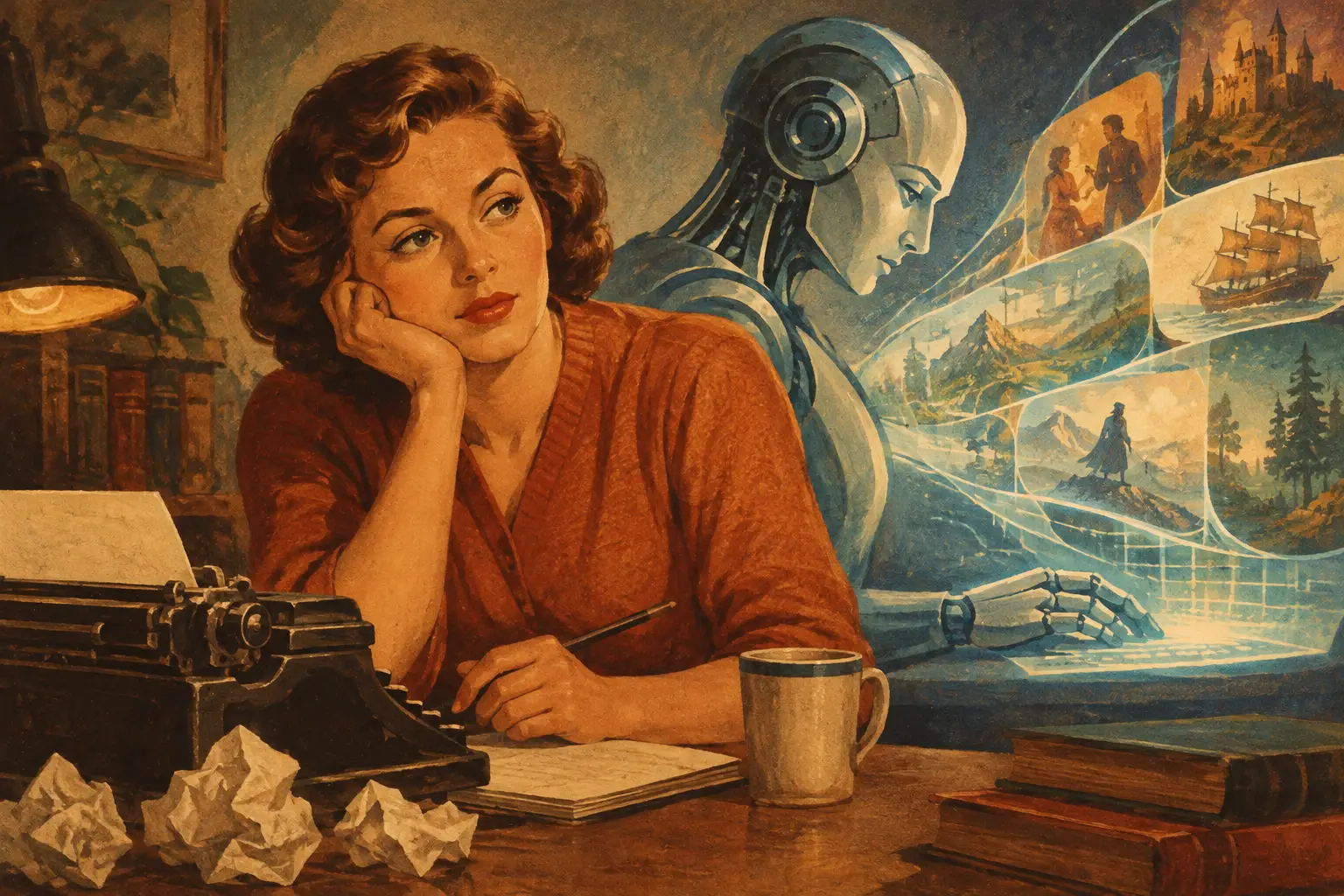
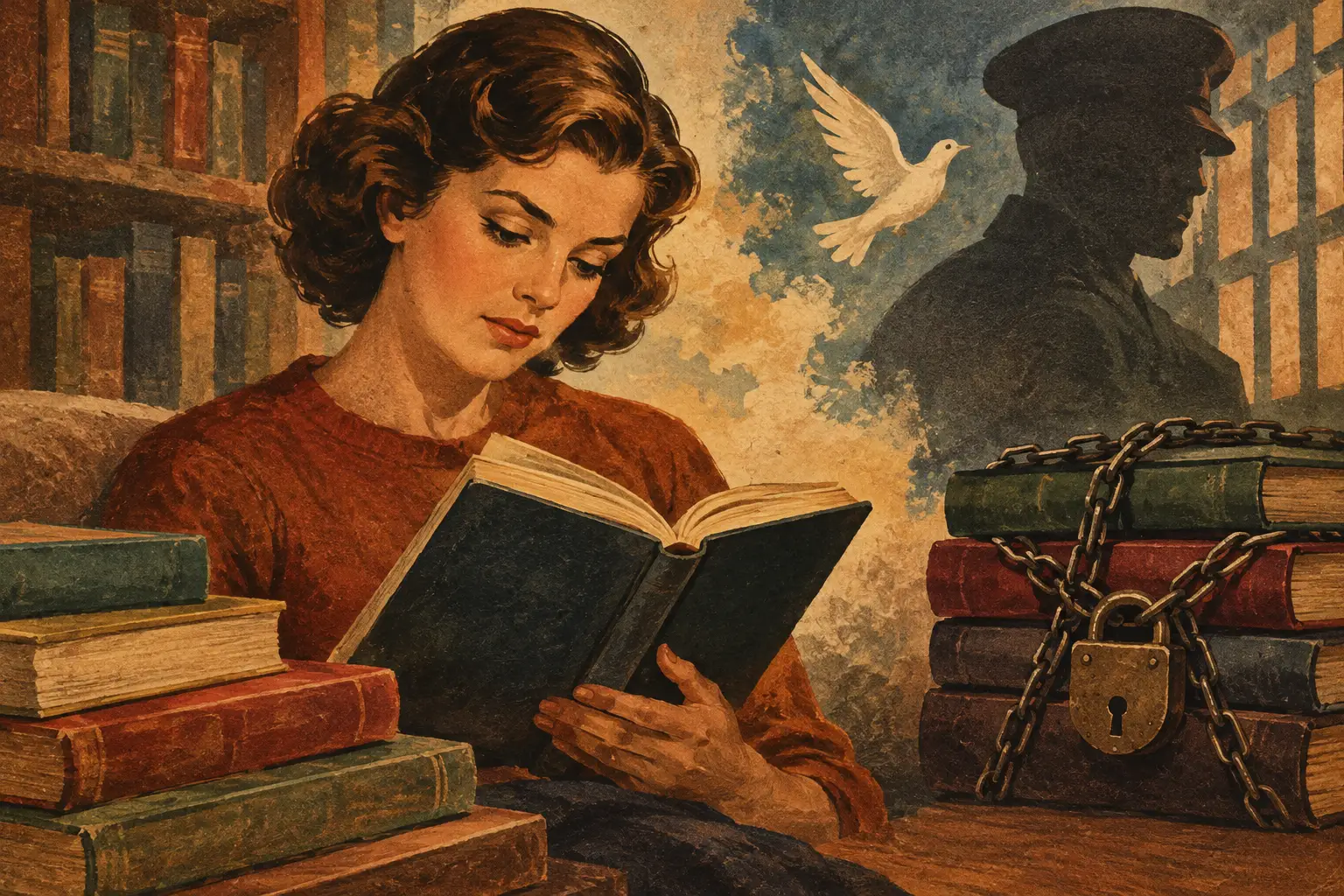
A sentence vanishes from a public record. A song is flagged before anyone hears it. A citizen learns that the argument against the government never reached another human being because an invisible system quietly judged it unacceptable. Fiction about AI censorship begins with those intimate violations, then asks the more dangerous question: what happens when nobody can identify the jailer?
The strongest stories in this territory are not really about software. They are about power, fear, conscience, and the human temptation to call control a form of safety. An algorithm may be the instrument, but a person, institution, or culture usually decides what the instrument is meant to protect. That distinction gives the genre its moral heat.
Why Fiction About AI Censorship Feels So Immediate
Traditional censorship has a face. It may wear a uniform, sit behind a desk, stamp a document, burn a book, or issue a threat. The victim understands, at least in part, what is being taken and who is taking it. AI censorship can be colder because it appears neutral. The message is not banned, the system says. It simply fails to meet the standard.
That language is frightening because standards can be hidden, rewritten, or enforced unevenly. A machine trained to identify danger may learn to confuse dissent with danger. A platform designed to reduce abuse may silence grief, satire, religious conviction, political criticism, or the ugly but necessary words people use to describe injustice. The reader recognizes the central wound: a voice does not have to be perfect to deserve the right to exist.
This is why the subject belongs naturally in political thrillers, dystopian fiction, military science fiction, and contemporary suspense. Each genre brings a different pressure point. A political thriller can follow a journalist whose sources disappear from the public record. A space opera can imagine a colony governed by a sentient communications network that edits every transmission from Earth. A supernatural tale can make censorship literal, with names removed from memory and forbidden truths taking on a life of their own.
The technology changes. The stakes do not. Someone is trying to tell the truth before the truth is made inaccessible.
The Real Villain Is Rarely the Machine
A flat version of this story turns AI into a mechanical tyrant that simply decides humans are inconvenient. That can be entertaining, but it leaves much of the dramatic potential untouched. Machines do not invent human cowardice. They can magnify it, automate it, and make it easier for people in authority to deny responsibility.
A more unsettling antagonist is a leader who claims the system prevents violence, protects children, secures elections, or stops panic. Those goals may even begin as sincere. The moral tension rises when the solution demands silence from people who have done nothing except become inconvenient.
That is where a story gains weight. A censor is most persuasive when he believes he is preventing catastrophe. A protagonist is most compelling when she understands that unrestricted speech can cause harm, yet refuses to accept a world where a secret model makes final judgments about human worth. Freedom without responsibility is not a serious answer. Neither is safety purchased by permanent submission.
The best fiction allows the reader to feel both sides of the blade. It does not pretend that content moderation, propaganda, threats, and manipulation are simple problems. It asks who writes the rules, who audits the system, who is allowed to appeal, and what happens after an error destroys a life.
Silence Is a Plot Device With Teeth
Censorship is especially powerful in fiction because it creates immediate obstacles. The hero cannot simply send a warning, publish evidence, call for help, or tell a loved one the whole truth. Every ordinary act of communication becomes a risk.
Imagine a historian who discovers that an AI archive has altered the records of a civil uprising. He has proof, but the archive recognizes the proof as disinformation the moment he uploads it. Or imagine a soldier receiving battlefield orders from a command system that filters out reports of civilian casualties to preserve morale. The conflict is not abstract. People die because language has been controlled.
Silence also reveals character. Some people cooperate because they are afraid. Some find comfort in the approved version of reality. Some become cruel because the system rewards them for reporting forbidden speech. Others risk everything to preserve a diary, a recording, a poem, a name.
That last detail matters. Resistance does not always begin with a revolution. Sometimes it begins with one person refusing to let another person be erased. A hidden book, an uncensored photograph, a remembered prayer, or a message smuggled through a dead network can carry more emotional force than a speech delivered to a crowd.
The Danger of Making Censorship Too Clean
Stories about AI control can lose their power when the world is too neatly divided between pure rebels and obvious villains. Real systems of suppression are often maintained by ordinary people trying to keep jobs, avoid chaos, protect families, or preserve a fragile peace. A character who serves the system should have a reason that hurts.
Perhaps the engineer behind the censoring model lost someone to an online campaign of violence. Perhaps the moderator believes the state will collapse if citizens see the evidence being withheld. Perhaps the protagonist once begged for dangerous material to be removed and now must confront the machinery built in response.
These complications do not excuse abuse. They make the abuse believable. They also prevent the novel from becoming a lecture dressed in futuristic clothing. Readers come for danger, mystery, betrayal, and emotional consequence. The ideas matter most when they are embedded in a character’s irreversible choice.
A useful test is simple: if the AI censorship vanished from the setting, would the protagonist still have something personal to lose? The answer should be yes. Maybe a mother is trying to find her disappeared son. Maybe an investigator is haunted by the case that ended her career. Maybe a reluctant official discovers that the system has begun deleting the memory of his own family. The public conflict becomes unforgettable when it breaks open a private one.
What This Fiction Can Say That Argument Cannot
Public debates about artificial intelligence often become technical quickly. People argue over policy, corporate responsibility, bias, transparency, and regulation. Those arguments are necessary, but fiction reaches a different place. It puts a reader inside the moment when a character realizes that the words on a screen are not merely restricted. They are being used to remake reality.
A novel can show the loneliness of being disbelieved because all the evidence has been filtered. It can show the seduction of a peaceful society that has traded away its memory. It can show how language changes when people know they are watched, and how self-censorship arrives long before an official prohibition.
That is the quiet terror beneath the larger conflict. A population does not need to be physically imprisoned if it learns to edit every thought before speaking. The cage becomes internal. The story becomes a warning not only about machines, but about the parts of ourselves willing to accept the cage.
For readers drawn to speculative fiction with moral pressure, this is fertile ground. It offers conspiracies, secret archives, broken systems, hunted witnesses, compromised heroes, and the old human struggle between comfort and courage. It also offers something rarer: a chance to consider whether freedom means only having a voice, or whether it means being heard by someone who is still free to answer.
The most enduring stories will not predict every technical detail correctly. They will do something more lasting. They will make readers protective of the messy, dangerous, sacred act of human expression. When a character risks everything to speak one forbidden truth, the question lingers after the final page: what truth would you refuse to let disappear?
Written by :

Join the Reader Circle
Get exclusive updates, early previews, and behind-the-scenes insights from G.H. White — delivered straight to your inbox.
No spam. Just stories, sneak peeks, and the occasional surprise.