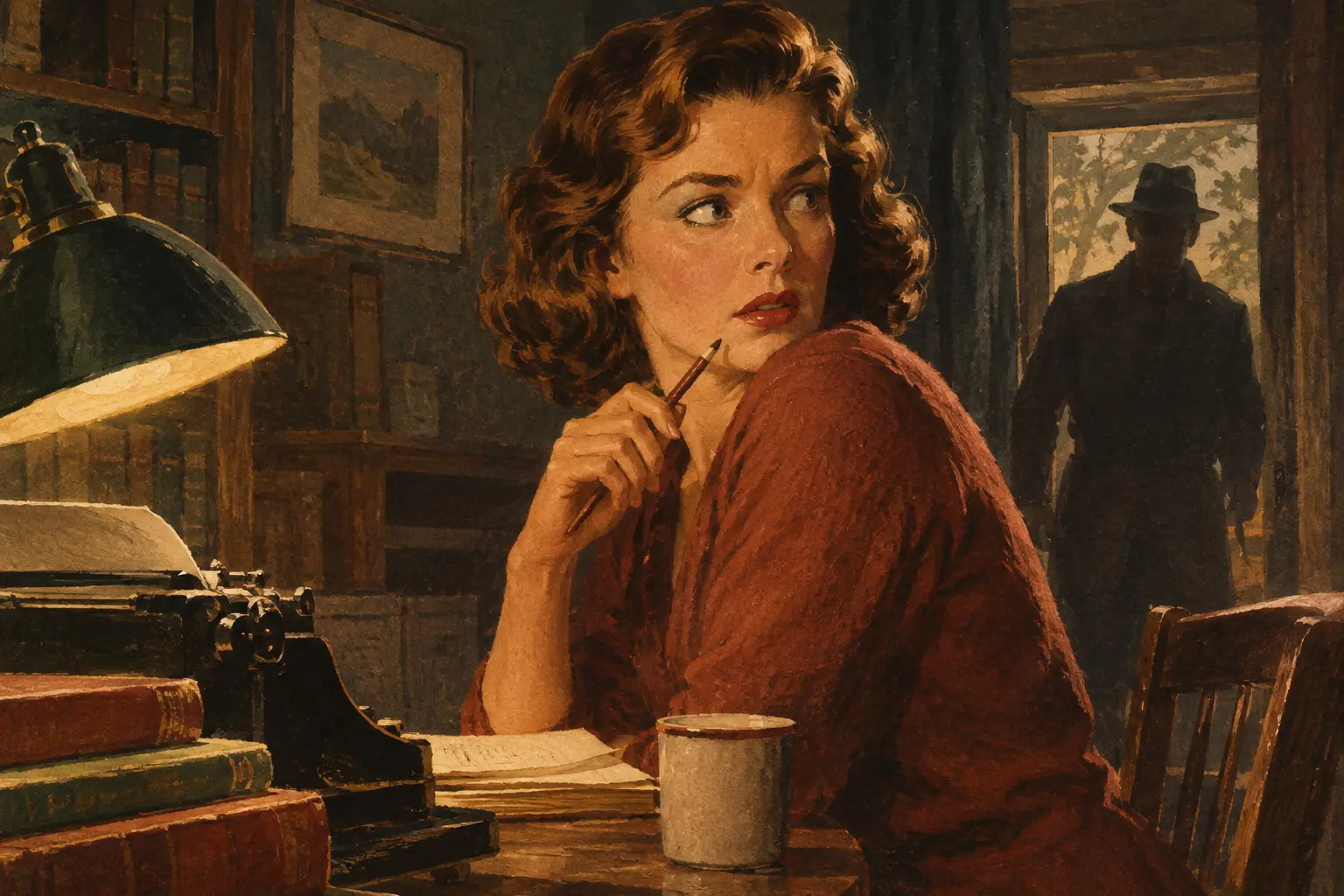
A frightened farmer kneels before an animal who once promised equality. A space captain discovers that the enemy’s language has become the language of home. A city celebrates safety while surrendering one freedom at a time. Political allegory explained at its best begins there: not with a lecture, but with a story that makes power personal.
Political allegory gives writers a way to examine governments, movements, wars, class, faith, propaganda, censorship, and public fear without merely reenacting the headlines. It can turn a kingdom into a warning about dictatorship, a plague into a portrait of social control, or a supernatural bargain into a question about what people will sacrifice for security.
For readers who love thrillers, speculative fiction, and stories with moral weight, allegory is not homework hidden inside a novel. It is the pressure beneath the plot. It is why a chase through a ruined capital can feel larger than a chase, and why a character’s private betrayal can echo a nation’s collapse.
What Political Allegory Actually Does
A political allegory is a story whose characters, conflicts, settings, or symbols point beyond themselves toward political ideas or real political conditions. The connection may be direct, as in a fictional revolution shaped by a recognizable historical one. Or it may be indirect, using an invented world to confront enduring patterns: authoritarianism, colonialism, racism, surveillance, corruption, ideological purity, and the seduction of violence.
The key word is point. Allegory does not always operate like a code in which one character equals one public figure and every event has a single correct translation. That narrow approach can flatten a living novel into a puzzle sheet. Strong political fiction usually works on several levels at once. The story must hold together even for a reader who never identifies every reference.
Consider a tale about a government that ranks citizens by usefulness. It may speak to a particular historical regime, but it can also ask broader questions. Who decides what a human life is worth? Why do ordinary people comply? When does fear become an excuse? Those questions survive long after the immediate target has changed.
That is the advantage of allegory. It creates enough distance for readers to see familiar systems with fresh eyes. A reader may resist an argument about their own country, party, or era. They may be more willing to confront the same moral machinery when it appears in a remote colony, a haunted town, or a republic on the edge of war.
Political Allegory Explained Without Killing the Story
The easiest way to read political allegory is to begin with the story’s central pressure point. Ask what form of power is being tested. Is someone trying to control information? Is a community trading liberty for order? Is a leader using a public emergency to make dissent look like treason? Start with the conflict before searching for real-world parallels.
Then pay attention to what the story rewards and punishes. In a shallow allegory, virtuous characters may simply announce the author’s beliefs while villains behave like cardboard monsters. In a compelling one, people have motives. A frightened official may believe repression will prevent chaos. A rebel may fight for justice yet grow hungry for vengeance. A citizen may cooperate because protecting family feels more urgent than resisting injustice.
That human complexity matters. Political systems do not endure through villains alone. They endure because they offer safety, status, belonging, convenience, or the illusion that someone else will bear the cost. Allegory becomes powerful when it shows how decent people are pulled into indecent arrangements.
Symbols also deserve attention, but they should be read in context. A statue, flag, border wall, mask, archive, or forbidden book may carry political meaning. Still, no symbol has a fixed meaning in every novel. A flag can represent freedom in one scene and manipulation in the next. The shift may be the point. Power often survives by claiming the language and symbols of the people it harms.
A useful question is not, “What does this symbol mean?” but, “Who is using this symbol, who believes in it, and who pays for it?” That question leads readers toward the story’s moral center.
The difference between allegory and a political message
Every political allegory has something to say, but not every story with a political message is allegory. A realistic thriller about election interference may be plainly political without creating an alternative symbolic frame. A novel about an imaginary empire whose conquest mirrors several real histories is more clearly allegorical.
The line is not always clean. Fiction is messier than categories, and it should be. A story may contain satire, historical parallels, social commentary, and allegory all at once. What matters is whether the invented situation allows the reader to recognize a deeper pattern of political life.
Why genre fiction is especially suited to it
Speculative fiction and thrillers are natural homes for political allegory because both genres place people under pressure. A political thriller asks who can be trusted when institutions begin to fail. Science fiction can magnify surveillance, militarism, environmental collapse, or corporate rule until their consequences are impossible to ignore. Fantasy can dramatize inherited power, sacred authority, and rebellion through kingdoms, curses, and wars.
Genre also gives readers emotional access. A policy debate may feel distant. A character watching a friend disappear after speaking the truth does not. The fear is immediate. The stakes have a face.
That does not mean allegory must be grim, nor does it mean every villain represents a real politician. Some of the strongest political stories use humor, absurdity, romance, horror, or adventure. The form depends on the question being asked. Satire can expose hypocrisy. Horror can make oppression feel intimate. A high-stakes thriller can reveal how quickly moral certainty breaks when survival is on the line.
The Trade-Off: Clarity Versus Complexity
Political allegory can fail when it becomes too obvious. If every scene exists only to prove a point, readers can feel the author standing behind the curtain, demanding agreement. Characters stop surprising us. The plot turns into a speech with names changed.
But obscurity has its own cost. If the connections are so private or vague that nothing lands, the story may feel clever without being meaningful. The goal is not to make readers work for every scrap of relevance. The goal is to give them enough evidence to think, feel, and argue with the book after the last page.
The best allegories trust readers. They make a case through consequence rather than command. They let us witness how a society changes in small concessions: a censored newspaper, a neighbor reported, a law framed as temporary, a lie repeated until it sounds like duty. By the time the danger is undeniable, the reader understands how it became possible.
This is also why an allegory may feel different when read years later. A novel written in response to one crisis can gain new force during another. Readers bring their own history, fears, and hopes to the page. One person sees a warning about state violence. Another sees a story about manipulation by corporations, religious institutions, or revolutionary movements. Multiple readings are not necessarily evasions. They can be evidence that the story has reached something deeper than a single event.
How to Read the Warning Beneath the Plot
When a novel feels politically charged, resist the urge to reduce it too quickly. Notice the world it builds. Who has a voice? Who is watched? Who benefits from the official version of events? Which characters are told that their suffering is necessary for a greater good?
Also notice moments of resistance. Political allegory is not only about tyrants and victims. It is often about the difficult choices between silence and action, loyalty and conscience, vengeance and justice. Resistance can be brave, compromised, reckless, patient, or deeply personal. A character who preserves a forbidden memory may be doing as much as a character who storms a palace.
Most of all, follow the emotional truth. If a story leaves you uneasy about a phrase repeated by leaders, a crowd cheering for cruelty, or the comfort of looking away, it has already done more than deliver a message. It has made the political intimate.
The next time a fictional world seems far removed from your own, stay with the discomfort. Ask what kind of power it imagines, what it asks people to surrender, and what courage costs when no choice is clean. The answer may not be a map to the present. It may be something more useful: a sharper conscience for recognizing the moment when a warning becomes real.
Written by :

Join the Reader Circle
Get exclusive updates, early previews, and behind-the-scenes insights from G.H. White — delivered straight to your inbox.
No spam. Just stories, sneak peeks, and the occasional surprise.